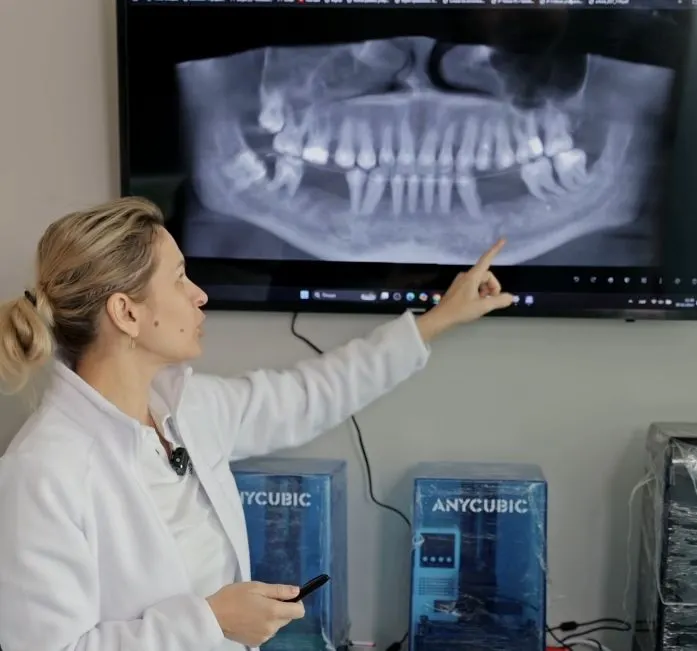
Generalized periodontitis is a serious disease of the gums and bone tissue that often leads to loosening and loss of teeth. In such cases, the periodontist literally “fights” for each tooth, trying to stabilize the situation and preserve those elements of the dentition that can still be saved.
However, in advanced cases, it is not always possible to avoid losses. In the absence of teeth, the patient is faced with the problem of restoring chewing function and smile aesthetics. The situation is complicated by the fact that in generalized periodontitis, the bone supply is usually minimal – that is, the volume of bone for implant placement is limited.
How modern technologies help
Traditional implantation in conditions of insufficient bone can be difficult and require additional surgeries (bone grafting, sinus lift, etc.). Modern dentistry offers more precise and gentle solutions.
In our clinic, implantation is performed using a navigation template. This is a special individual device that is manufactured in our laboratory and allows the surgeon to place the implants in the optimal position with jeweler's precision.
How to create a navigation template
- Scanning – the doctor performs a digital scan of the patient's jaws and a computed tomography scan to obtain the most accurate 3D model.
- Planning – using special software, the ideal location for each implant is determined, taking into account the available bone volume and anatomical features.
- Template creation – the laboratory creates an individual navigation template that guides the doctor during surgery with an accuracy of up to a tenth of a millimeter.
Advantages of this approach:
• minimal trauma;
• high accuracy and predictability of the result;
• shortened recovery period;
• the possibility of installing implants even in complex cases with insufficient bone volume.
Thus, even with generalized periodontitis and difficult conditions, a full smile can be restored using modern digital technologies and navigational implantation.